
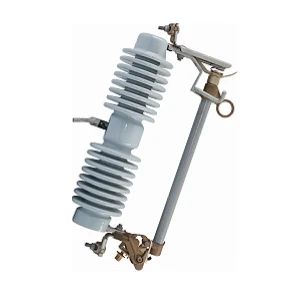
If you have ever looked up at a utility pole and seen a small brown porcelain device with a tube hanging down from it, you were looking at a porcelain fuse - more precisely a porcelain drop-out fuse cutout. Despite its modest size, this device performs one of the most important jobs on an overhead distribution network: it protects expensive equipment from electrical faults and gives linemen a visible, safe way to isolate a section of line. For overseas buyers specifying distribution hardware, understanding what a porcelain fuse is actually used for - and how to select one - is essential.
What Exactly Is a Porcelain Fuse?
A porcelain fuse, commonly called a cut-out fuse or drop-out cutout, is a combination of a fuse and a switch mounted on a ribbed porcelain insulator. It is installed on primary overhead feeder lines and taps, almost always directly ahead of a distribution transformer. The assembly has three main components:
The porcelain insulator body - a glazed, ribbed ceramic that mechanically supports the live parts and electrically isolates them from the pole or crossarm.
The fuse carrier (or "door"/tube) - a hinged fiberglass tube containing a replaceable fuse link. When the link melts, the carrier drops open on its hinge.
The contact assembly - precision upper and lower contacts that carry current normally and release the carrier when the fuse operates.
The insulator is made of high-strength brown or grey glazed porcelain that resists ultraviolet light, pollution and thermal cycling, which is why "porcelain" is part of the product's everyday name.
Primary Use 1: Overcurrent and Short-Circuit Protection
The dominant job of a porcelain fuse is to clear faults. Under normal conditions, current flows through the fuse link with negligible resistance. If a downstream fault occurs - a short circuit in the transformer, a tree contacting a line, or a sustained overload - the calibrated fuse link melts. An arc forms inside the fiberglass tube; the heat vaporizes the arc-extinguishing lining (often boric-acid or cellulose based), producing high-pressure gas that stretches, cools and de-ionizes the arc until it is extinguished at a natural current zero. Quality cutouts clear transformer faults in roughly 0.5 to 5 cycles, limiting damage and keeping the outage localized to the affected section rather than tripping the whole feeder.
Primary Use 2: Visible Isolation for Safety
The second defining function is visual. When the fuse blows, the carrier drops to a near-vertical hanging position - typically rotating at least 90 degrees from horizontal. This is unmistakable evidence, even from the ground, that the circuit is open. The physical air gap created by the dropped carrier is a genuine safety feature: it supports lockout/tagout (LOTO) procedures and lets linemen confirm the line is de-energized before work begins. This is something a hidden, panel-mounted fuse cannot offer.
Primary Use 3: Manual Switching and Sectionalizing
A porcelain fuse also doubles as a switch. A linemen standing on the ground can pull the carrier open with an insulated "hot stick" via its pull ring, isolating a transformer or a section of feeder for maintenance. On radial circuits, cutouts placed every 3 to 5 poles split a long feeder into sections, so a fault only interrupts a small part of the network. A "load-break" version with an arc-quenching attachment is used where switching under load is required; standard cutouts are not intended to be opened under load. Replacing a blown fuse link in the field takes minutes and costs a fraction of replacing a switchgear assembly.
Porcelain vs Polymer Bodies
Porcelain bodies are time-proven, UV-stable and mechanically rigid, with bird-proof ceramic designs available. Polymer (silicone rubber) bodies are lighter, resist vandalism and perform well in high-pollution or coastal areas, with materials tested to 1,000-hour salt spray. Both comply with the same electrical standards; the choice depends on site conditions and handling preferences.
About EC Insulators (ECI)
EC Insulators (ECI) is a China-based manufacturer serving more than 69 countries from 60,000 m² of ISO 9001:2015 certified facilities. Alongside its core composite and ceramic insulators and surge arresters, ECI produces silicone and porcelain fuse cutouts for outdoor medium- and high-voltage distribution systems, built to IEC 60282-2 and ANSI C37.41/C37.42. Cutouts are available with porcelain or polymer bodies, NEMA brackets, arc-shortening rods and K/T-type fuse links. The engineering team supports buyers with rating, coordination and creepage selection. For data sheets, test reports or a project quotation, contact info@ec-insulators.com.